Tuesday, June 18, 2013
Cade - graphics framework for Pharo
There is Cade - a graphics framework for Pharo using Athens. Here is the link including a demo video.

Monday, June 17, 2013
Presenty
Presenty is a user interface framework for Pharo based on MVP (Model view presenter). Read more about it on Denis blog.
Code is on SmalltalkHub.
Friday, June 14, 2013
STIC 13 - VA Smalltalk Roadmap
First video recorded by James from this months "STIC 13" conference, Wigwam resort, Phoenix Arizona (June 9-12). Expect more to come in the next days ...
Barcodes in Smalltalk
Didnt know Barcodes are so easy to implement in Smalltalk. So I started with EAN13 barcode together with unit tests.
Project lives on: http://smalltalkhub.com/#!/~TorstenBergmann/Barcode
You can also load it using the config browser in Pharo 2.0 now. It is already usable - thanks to the power of Pharo.
Short Guide:
To instantiate: BarcodeEAN13 value: '2109876543210'
You can get the binarySequence of a barcode:
(BarcodeEAN13 value: '2109876543210') binarySequence
calcuate the checksum (last digit):
(BarcodeEAN13 value: '2109876543210') computeChecksum
or visualize the barcode:
BarcodeEAN13 example asForm asMorph openInWorld
or to write to a file:
PNGReadWriter putForm: BarcodeEAN13 example asForm onFileNamed: 'sample.png'
 Now includes EAN8 as well
Project lives on: http://smalltalkhub.com/#!/~TorstenBergmann/Barcode
You can also load it using the config browser in Pharo 2.0 now. It is already usable - thanks to the power of Pharo.
Short Guide:
To instantiate: BarcodeEAN13 value: '2109876543210'
You can get the binarySequence of a barcode:
(BarcodeEAN13 value: '2109876543210') binarySequence
calcuate the checksum (last digit):
(BarcodeEAN13 value: '2109876543210') computeChecksum
or visualize the barcode:
BarcodeEAN13 example asForm asMorph openInWorld
or to write to a file:
PNGReadWriter putForm: BarcodeEAN13 example asForm onFileNamed: 'sample.png'
Now includes EAN8 as well
Units in Smalltalk
I uploaded a "ConfigurationOfUnits" to the MetaRepoForPharo20. With this the "Units" framework is easily loadable from the Pharo 2.0 config browser.
Here are some examples from the Unit framework:
(10km + 10km) gives you 20km
You can also convert easily
(10km + 24m) as: 1m
gives you 10024 metres.
It is also simple to compare:
1hour < 10 seconds
which gives you false.
Here are some examples from the Unit framework:
(10km + 10km) gives you 20km
You can also convert easily
(10km + 24m) as: 1m
gives you 10024 metres.
It is also simple to compare:
1hour < 10 seconds
which gives you false.
Thursday, June 13, 2013
Wednesday, June 12, 2013
Log4s for Pharo
Log4s - a logging framework for Smalltalk was open sourced with MIT license by Instantiations. It runs on Pharo 2.0.
Some details about it can be found in this presentation.
Some details about it can be found in this presentation.
libsodium Binding for Pharo and Squeak
Magritte for Morphic
Magritte is a framework allowing you to easily build seaside apps by adding meta informations to domain classes that can be used to easily build the UI.
Now there is also support for Morphic available. Just watch the video.
Now there is also support for Morphic available. Just watch the video.
Sunday, June 09, 2013
Tab widget
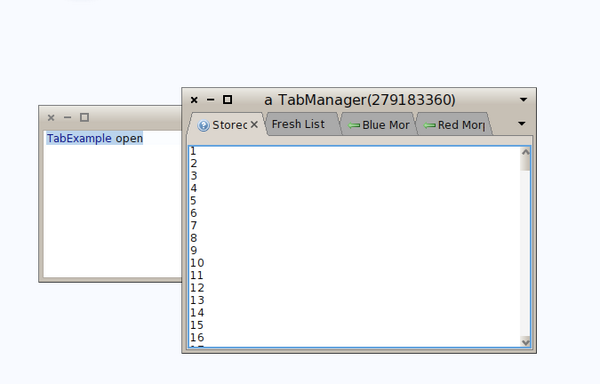
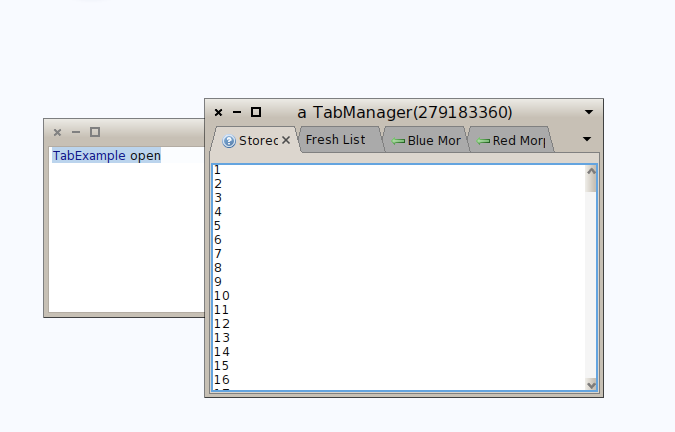
Benjamin implemented a better Tab widet for Pharo. Code is on SmalltalkHub and it was today integrated into Pharo 3.0.
Nice!
Nice!
Circular Menues
Pharo will soon support circular menues. Here is a video demonstrating this feature.
Friday, June 07, 2013
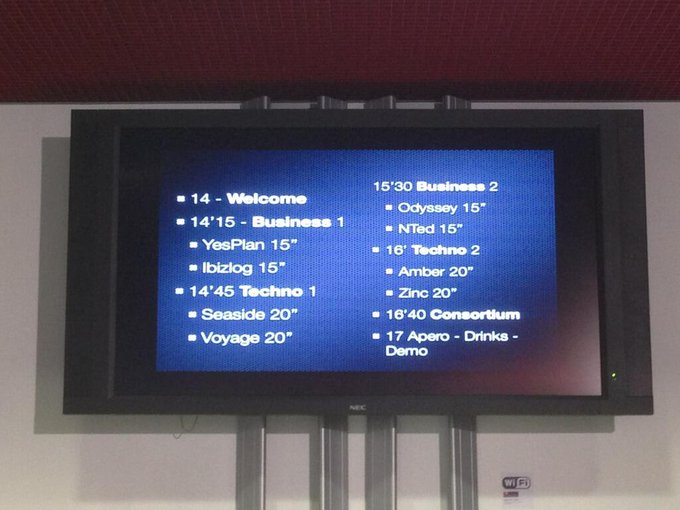
Web with Pharo Conference 6 June 2013 @ Lille
The program from yesterdays Pharo web conference is already on twitter:
 Lets see when the first videos appear on the web.
Lets see when the first videos appear on the web.
Thursday, June 06, 2013
Tektronix Smalltalk Document Archive
This page contains annotated links to primary documents related to the development of Smalltalk products at Tektronix in the 1980′s.
Amber Smalltalk on the iPhone
Sebastian Sastre is playing with Amber - so here is Amber Smalltalk running on the iPhone. Click the image to enlarge.

Wednesday, June 05, 2013
The Power of Clean Code
Pharo gets better and better - Sean DeNigris demonstrates this with a short video.
STIC 2013
The Smalltalk Industry Council STIC'13 Conference will be held next Sunday thru Wednesday, June 9-12 at the Wigwam Resort near Phoenix.
Tuesday, June 04, 2013
Sunday, June 02, 2013
SourceCity is OpenSource now
SourceCity is a 3D visualization tool for analyse object-oriented systems.
It is now OpenSource with MIT License! Read more.
Friday, May 31, 2013
Rubric demo for Pharo
Alain Plantec gives a first demo of Rubric (a deep refactoring of TextEditor) for Pharo in a new video:
http://vimeo.com/67400546
Code lives on SmalltalkHub.
http://vimeo.com/67400546
Code lives on SmalltalkHub.
Device prototype with Smalltalk from 1991
This device was a prototype for a pen computer called the "ActiveBook". Software part was done with Smalltalk.
Artefact 1.0 - PDF framework for Smalltalk
Artefact 1.0 is released - a project implementing a PDF framework for Smalltalk.
Project and code live at on SmalltalkHub. Read more about the features in the announcement.
To easily try out download Pharo 2.0, open the config browser and load the "Artefact" project.
Then check the class PDFDemos. If you evaluate "PDFDemos runAllDemos" you will find a "pdf" directory with all the PDF samples generated.
Project and code live at on SmalltalkHub. Read more about the features in the announcement.
To easily try out download Pharo 2.0, open the config browser and load the "Artefact" project.
Then check the class PDFDemos. If you evaluate "PDFDemos runAllDemos" you will find a "pdf" directory with all the PDF samples generated.
Smalltalk Debugging facilities for web development
A debugger is not only something a developer uses to hunt for bugs. It is also a tool that makes a developer more productive.
In Smalltalk the debugging experience is really impressive. As someone once said:
"I love Smalltalk. I love coding in the debugger, being able to archive processes and restore them exactly later if they encounter exceptions, the amazing reliability. The economy of expression and the brilliant class library."
Soon Amber Smalltalk will bring this debugging experience also to web development. Have a look at this demo video.
In Smalltalk the debugging experience is really impressive. As someone once said:
"I love Smalltalk. I love coding in the debugger, being able to archive processes and restore them exactly later if they encounter exceptions, the amazing reliability. The economy of expression and the brilliant class library."
Soon Amber Smalltalk will bring this debugging experience also to web development. Have a look at this demo video.
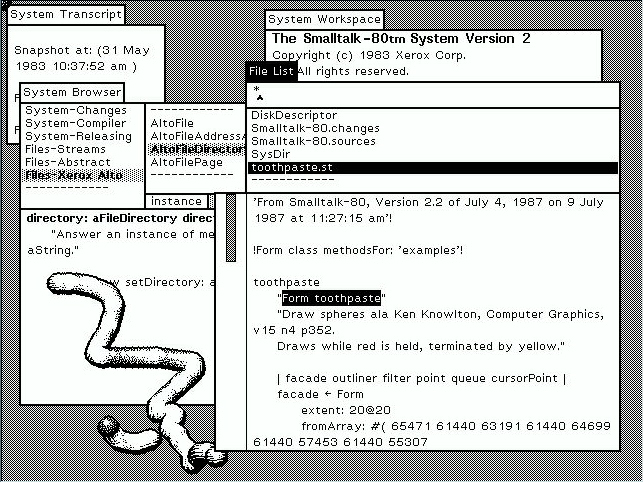
Some Smalltalk history
A picture provided by Allan Wirfs-Brock with the following comment:
"And this was how you coded a fast Smalltalk virtual machine in 1985"
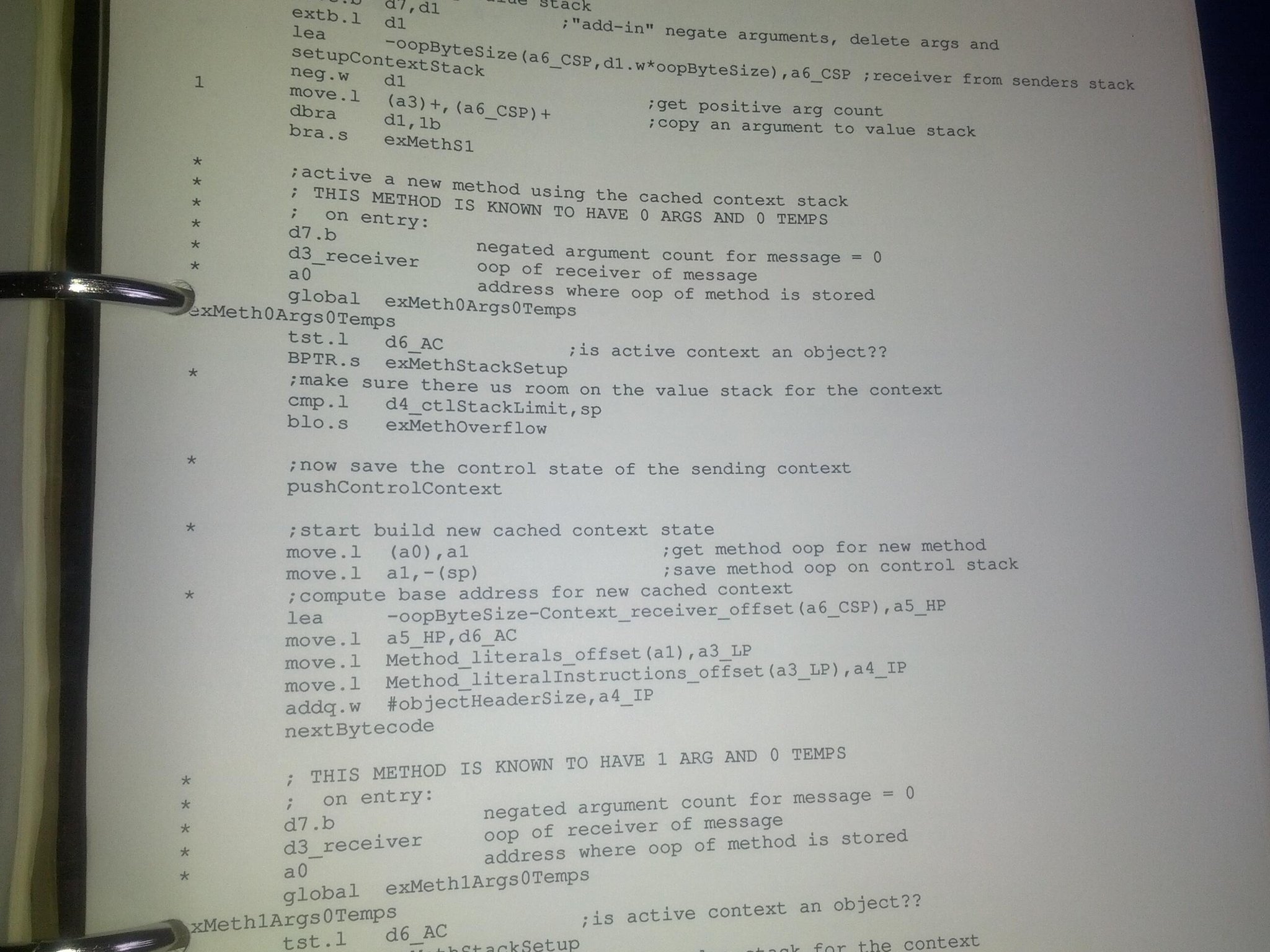
"And this was how you coded a fast Smalltalk virtual machine in 1985"
Thursday, May 30, 2013
Reflectivtity for Pharo
Reflectivity for Pharo is out - this tool allows you to annotate
AST nodes with "metalinks". Read more.
Friday, May 24, 2013
HPI Seaside Tutorial updated
The Seaside tutorial from HPI Potsdam is updated and there are two new chapters about testing and web feeds.
Thursday, May 23, 2013
Experimental White Space theme for Pharo
Pharo supports UI theming and there is now a new experimental "White space theme" from Tudor.
Web with Pharo
peer.js and Amber Smalltalk
There is a new binding to peer.js for Amber. You can find the project here.
Tuesday, May 21, 2013
To trap a better mouse
Ian Piumarta (Squeak Unix VM maintainer, long time Squeaker and Smalltalker) who is working for Viewpoints Research Institute will speak Wednesday May 29, 2013, 3:30 pm at Room W1008, West Building 8W, Ookayama campus, Tokyo Institute of Technology about "To trap a better mouse".
Monday, May 13, 2013
Suggestions in Pharo 3.0
The upcoming Pharo 3.0 provides "suggestions" in the code editor. Here is a demo video.
High-Level Musical Concepts in µO
There is a new paper available about Musical concepts represented in Smalltalk code.
Monday, May 06, 2013
Sunday, May 05, 2013
Kinematic Templates in Smalltalk
The Kinematic Templates interaction technique suggests adjusting the user's
mouse input to it tends to match a drawing template. That allows the user
to draw in free-hand mode and obtain a "beautified" version of it's hand
drawing.
There is an implementation for Pharo. Read more or watch the video or read the paper.
There is an implementation for Pharo. Read more or watch the video or read the paper.
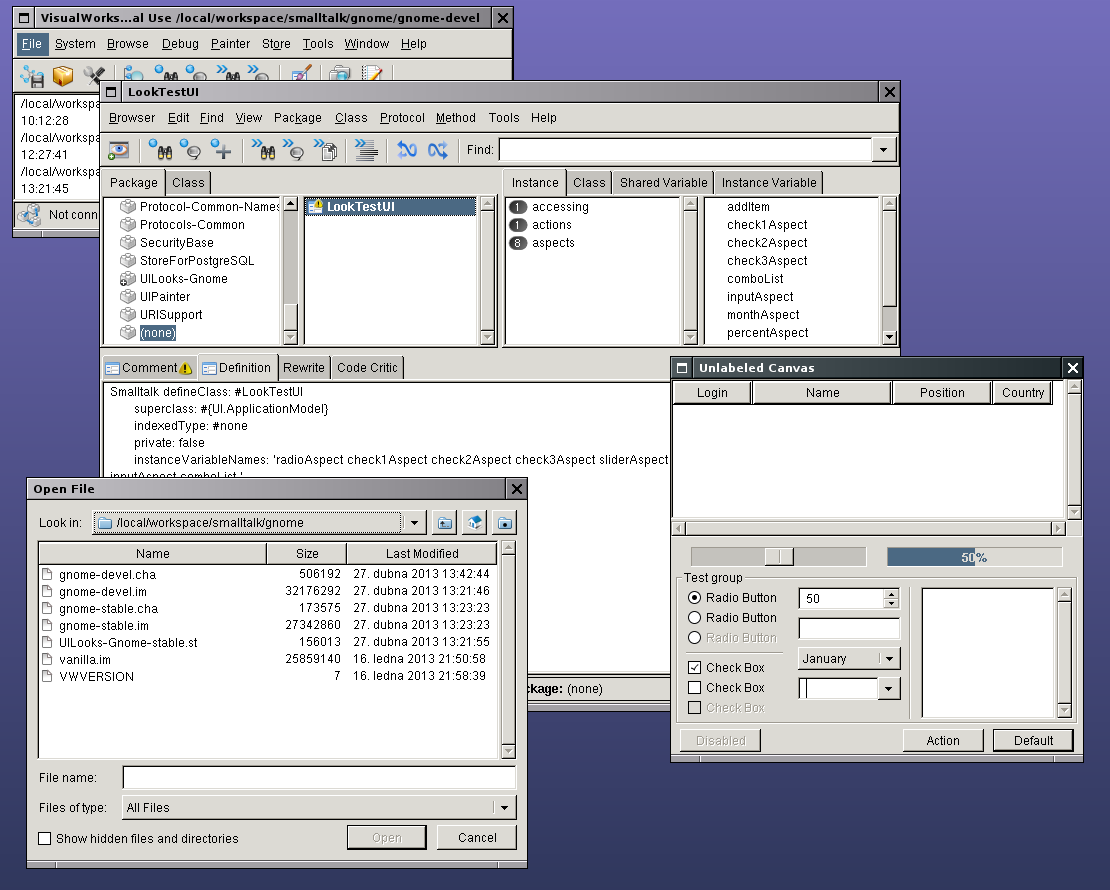
Redline ST IntelliJ plugin
There is now a preview video for the IntelliJ IDEA Redline Smalltalk plugin available.
Saturday, May 04, 2013
Your own SmalltalkHub
If you want to implement a feature in SmalltalkHub then just use your own private SmalltalkHub instance to implement.
Friday, May 03, 2013
Gemstone
Leaving VMWare Gemstone is now independent again moving Smalltalk products forward:
http://gemtalksystems.com
http://gemtalksystems.com
BabyMock 1.0
BabyMock is a visual mock object library for Pharo Smalltalk. Read more here or read the docu on SmalltalkHub.
Thursday, May 02, 2013

Thursday, April 25, 2013
Elasticsearch with Smalltalk
Elasticsearch claims to be a "flexible and powerful open source, distributed real-time search and analytics engine for the cloud". There is now a Pharo binding available for it from Paul.
Sqnappy - a Squeak/Pharo binding of the snappy compressor library
Snappy is a compression/decompression library. Its does not provide best compression - but is very fast. Now there is a Squeak/Pharo binding to the compressor library available. Read more here.
ESUG 2013 Call for Participation
You can find more infos about this years ESUG on James blog or from Stefs initial post.
Wednesday, April 24, 2013
Smart Suggestions for Pharo
The idea of "Smart Suggestions for Pharo" is to have suggestions based in the text selected or the cursor position in the code editor.
Read more about and see some screenshots here.
Read more about and see some screenshots here.
Monday, April 22, 2013
Saturday, April 20, 2013
Processing MJPEG streams with Pharo Smalltalk
Nice samples of how to view and capture MJPEG streams with Pharo Smalltalk.
Wednesday, April 17, 2013
ObjC bridge for Pharo
Esteban is working on an ObjC bridge for Pharo. Here is a first demo video comparing graphics within the world canvas and outside of the usual Morphic World using the bridge.
Tuesday, April 16, 2013
Pharo 3.0 and Opal compiler
After Pharo 2.0 came out the development on 3.0 immediately started.
Pharo 3.0 already has many new updates and today it also integrates Opal (a new compiler).
If you want to know more about Opal then read here or look at this presentation from the Deep into Smalltalk summer school.
Still Opal is not the default compiler - but step by step...
Pharo 3.0 already has many new updates and today it also integrates Opal (a new compiler).
If you want to know more about Opal then read here or look at this presentation from the Deep into Smalltalk summer school.
Still Opal is not the default compiler - but step by step...
Monday, April 15, 2013
The rationale behind Spec
the new way to define composable UI's in Pharo is summarized here and there is a tech report also available.
Sunday, April 14, 2013
PharoConf Videos
Three videos from PharoConf
- Building UIs with Spec: https://www.youtube.com/watch?v=P98-qpLUvQQ
- Data Migration with Moose: https://www.youtube.com/watch?v=8SGHV1lCry0
- Pharo Roadmap: https://www.youtube.com/watch?v=9xRVzzjgPu8
- FileSystem-Git: https://www.youtube.com/watch?v=4qld2mDIbg4
Friday, April 12, 2013
Athens Tutorial
Want to use the new Athens graphics package? There is a new tutorial that you can run from within the image.
This video from James shows how to use it.
Thursday, April 11, 2013
Profiling using Spy framework
Alexandre Bergel is demonstrating some profiling and visualization of the Spy framework. He uses package "HelpSystem" - stuff that I wrote back in 2010. Interesting point of view on things I did myself in the past. Looks like I should apply these visualizations to the new Online Help system as well to get even better results.
Thanks!
Wednesday, April 10, 2013
Interactive Smalltalk
A really nice video from Esteban that demonstrates the interactive nature of Smalltalk development and scripting facilities - here with Pharo. The demo is using Storm (a small game engine).
Monday, April 08, 2013
Pharo Resource page
James Robertson is offering a "Pharo Resource page" with links to his videos about Pharo. Nice!
Sunday, April 07, 2013
First 13 minutes of PharoConf
First 13 minutes of Pharo conference are available as video. Others are in preparation.
Pharo package for Ubuntu
There is now also a special Pharo package for Ubuntu, so you can easily install it. Read more.
Friday, April 05, 2013
Amber Smalltalk Game
A nice demo of an in-browser game developed in Amber Smalltalk is available
since today. Click here to try or read here.
If the demo runs in your browser click on "class browser" to see the code.
since today. Click here to try or read here.
If the demo runs in your browser click on "class browser" to see the code.
Thursday, April 04, 2013
Quicksilver
Quicksilver is a tool for the interactive exploration of hierarchical graphs. Code is on SmalltalkHub.
Wednesday, April 03, 2013
Athens Vector graphics tutorial for Pharo
Athens is a new vector graphics API for Pharo. There is now an in-image tutorial
from Igor you can use to get used to it. Really nice!
Trying Parasol with Selenium in Pharo Smalltalk
Johan Brichau answered my question from my last post: about the difference between the "Parasol" and "Webtester":
Now in Pharo 1.4 image I installed Parasol using:
Took a while since it loads Seaside. After anything is set up I can easily script the webdriver/Firefox from a Smalltalk workspace. Here is an example:
So it is easy to write SUnit tests or automate some tasks you do on the web using Pharo. With the help of F12 in the webbrowser it is easy to find out about element ids, ... in HTML, so one can easily navigate through pages.
I worked with Selenium in Java and other languages already in the past. Parasol is not as comfortable as with the Selenium IDE recorder - but it works and using Smalltalk usually makes one more productive.
It is nice to see that I can now also control the Firefox browser to automate things and write webtests directly from within Pharo Smalltalk.
- WebTester was written for Selenium RC (aka Selenium 1) using an old protocol
- Beach-Parasol is written for Selenium Webdriver (aka Selenium 2) using the JSONWire Protocol and can be seen as a replacement for WebTester
- a fresh Mozilla Firefox was already installed on my machine
- Parasol still requires old Pharo 1.4, so even when I prefer Pharo 2.0 I downloaded it again
- I installed the current version selenium-server-standalone-2.31.0.jar of Selenium which can be found here
java -jar C:\selenium\selenium-server-standalone-2.31.0.jar -Dwebdriver.firefox.bin="C:\Program Files (x86)\Mozilla Firefox\firefox.exe"
pause
Now in Pharo 1.4 image I installed Parasol using:
Gofer new
    url: 'http://ss3.gemstone.com/ss/Parasol';
    package: 'ConfigurationOfParasol';
    load.
((Smalltalk at: #ConfigurationOfParasol) project version: #development) load: 'dev'.

WAKomEncoded startOn: 8080.
Deprecation raiseWarning: false; showWarning: false.
Took a while since it loads Seaside. After anything is set up I can easily script the webdriver/Firefox from a Smalltalk workspace. Here is an example:
"Start the driver and open wikipedia"
driver := BPRemoteWebDriver new.
driver get: 'http://en.wikipedia.org/'.
"click on search"(driver findElementByID: 'searchInput') click.
"enter some text"driver getKeyboard sendKeys: ('Pharo' , (String with: BPKeys return)).
"query some text from the webpage"
Transcript show: ((driver findElementByID: 'mw-content-text') findElementByTagName: 'p') getText.

driver quit
So it is easy to write SUnit tests or automate some tasks you do on the web using Pharo. With the help of F12 in the webbrowser it is easy to find out about element ids, ... in HTML, so one can easily navigate through pages.
I worked with Selenium in Java and other languages already in the past. Parasol is not as comfortable as with the Selenium IDE recorder - but it works and using Smalltalk usually makes one more productive.
It is nice to see that I can now also control the Firefox browser to automate things and write webtests directly from within Pharo Smalltalk.
Parasol - web testing using Smalltalk
There is a project called "Parasol" allowing you to do web testing using Smalltalk. It uses Selenium.
Still dont know what the difference to "WebTester" is - which is another project for webtesting I already blogged about.
Tuesday, April 02, 2013
Pharo and GitFS
There is a GitFS available for Pharo. It is a work in progress and there is already some docu.
Fuel and Tanker demo session
First videos from PharoConf 2013 appear on the net. One video is about Tanker - an experimental package loader. It uses Fuel to do serialization and deserialization and will allow for faster loading.
Didnt know about the debugger menu item to serialize the stack to a .fuel file. Allows to serialize an error stack in case of problem and materialize the stack in another image to reproduce.
Nice - try that with other technologies out there ;)
Code for Fuel is already in Pharo 2.0. The Tanker project is on SmalltalkHub.
Didnt know about the debugger menu item to serialize the stack to a .fuel file. Allows to serialize an error stack in case of problem and materialize the stack in another image to reproduce.
Nice - try that with other technologies out there ;)
Code for Fuel is already in Pharo 2.0. The Tanker project is on SmalltalkHub.
Back to the command line with Pharo Smalltalk
Pharo 2.0 allows you to easily deal with the command line. This is very useful if you want to script some daily tasks or your CI builds.
You can pass arguments to the image and also register own command line commands. Just check out the class comment in class "CommandLineHandler" and check its subclasses.
Creating an own handler is easy: just subclass CommandLineHandler with a custom class:
Implement a class side method to return the command name:
and implement an instance side #activate method:
Now call it from the command line
$PATH_TO_VM myImage.image time
and it will print the current time on stdout. Note that the #activateHelp will activate the --help option which displays the class comment of your custom handler class.
Also note that it is now possible to write in colors in a terminal from Pharo as this photo shows (click to enlarge):

You can pass arguments to the image and also register own command line commands. Just check out the class comment in class "CommandLineHandler" and check its subclasses.
Creating an own handler is easy: just subclass CommandLineHandler with a custom class:
CommandLineHandler subclass: #TimeCommandLineHandler
 instanceVariableNames: ''
 classVariableNames: ''
 poolDictionaries: ''
 category: 'Custom-CommandLine'
Implement a class side method to return the command name:
commandName
 ^ 'time'
and implement an instance side #activate method:
activate
 self activateHelp.

 FileStream stdout
  nextPutAll: '[time] ';
  nextPutAll: Time now asString
Now call it from the command line
$PATH_TO_VM myImage.image time
and it will print the current time on stdout. Note that the #activateHelp will activate the --help option which displays the class comment of your custom handler class.
Also note that it is now possible to write in colors in a terminal from Pharo as this photo shows (click to enlarge):
Get Pharo easily
If you want to install Pharo on your platform you can go to:
http://files.pharo.org
and download the specific distribution for your platform from the platforms directory. For instance "Pharo2.0-win.zip" for Windows, "Pharo2.0-mac.zip" for Mac and "Pharo2.0-linux.zip" for Linux.
There is also a "Pharo2.0-portable.zip" if you change platforms often (just put it on a USB stick). Also note that Pharo 3.0 is already available there as well - so if you want to help with fixes and changes feel free to do so.
If you visit
http://get.pharo.org
there is another way to install it. This page includes the Zero conf script allowing you to easily
install Pharo using the command line. For Pharo 2.0 this is:
And you can use:
for the current stable release of Pharo and the PharoVM.
http://files.pharo.org
and download the specific distribution for your platform from the platforms directory. For instance "Pharo2.0-win.zip" for Windows, "Pharo2.0-mac.zip" for Mac and "Pharo2.0-linux.zip" for Linux.
There is also a "Pharo2.0-portable.zip" if you change platforms often (just put it on a USB stick). Also note that Pharo 3.0 is already available there as well - so if you want to help with fixes and changes feel free to do so.
If you visit
http://get.pharo.org
there is another way to install it. This page includes the Zero conf script allowing you to easily
install Pharo using the command line. For Pharo 2.0 this is:
wget -O - http://get.pharo.org/20+vm | bashAnd you can use:
wget --quiet -O - get.pharo.org | bashfor the current stable release of Pharo and the PharoVM.
Tuesday, March 26, 2013
Pomodoro for Pharo 2.0
The Pomodoro Technique is a time management method. There is now also a simple timer implementation for Pharo 2.0 available.

You can load the tool right from the config browser and it allows easy scripting from Smalltalk:
Read more about the details here.
You can load the tool right from the config browser and it allows easy scripting from Smalltalk:
   "Provide an action when pomodoro is finished"
   Pomodoro timerFor: 20 minutes
            whenFinishedDo: [ self inform: 'Pomodoro finished']
Read more about the details here.
Thursday, March 21, 2013
IRC Pharo
The old IRC channel #pharo-project about Pharo is now closed. So if you want to chat
about the Pharo environment use the new #pharo channel on freenode.
Moose 4.8 on Pharo 2.0
Moose moved to Pharo 2.0. All tests are green and the team recommends to use Pharo 2.0 in the future.
Wednesday, March 20, 2013
One-click is dead
Even when then new Pharo 2.0 is delivered as a one-click on the homepage, in the future
we will see OS specific packages for Win, Linux, Mac, ...
The platform specific builds are already in place.
The platform specific builds are already in place.
Monday, March 18, 2013
Wednesday, March 13, 2013
Sunday, March 10, 2013
VertiMeta
VeriMeta tests all the package of one metacello version in a semi-auto fashion. Read more here or watch this video.
Saturday, March 09, 2013
Wednesday, March 06, 2013
Cross dialect Smalltalk CI
Do you want to use cross dialect Smalltalk (Pharo, Squeak and GemStone) continuous integration service?
Then have a look at "builderCI" from Dale which is using GitHub and TravisCI.
Sunday, March 03, 2013
Friday, March 01, 2013
Thursday, February 28, 2013
Wednesday, February 27, 2013
OOP - a critical approach
Some years ago I had email exchange with Huw Collingbourne about
programming and Smalltalk and Smallscript/S# in particular. At this time I helped my friend David Simmons a little bit with some early
Smallscript releases.
Huw runs the http://www.bitwisemag.com and he had a tutorial on Smalltalk with Squeak and one about Dolphin Smalltalk.
Huw also published an interview with David as the creator of Smallscript. Smallscript (as some of you may know) is still closed and not released into the wild for various reasons. It is still one of the most fascinating software technologies and dynamic scripting environment/language I was able to get my hands on.
But I dont want to write about Smallscript here.
Huw Collingbourne is instructor on programming languages, he wrote books about Ruby and is director of technology at SapphireSteel Software (known for their Ruby IDE).
I found an interesting post about Smalltalk and other programming languages in the context of object oriented programming from Dec 2012 written by Huw:
https://www.udemy.com/blog/object-oriented-programming-a-critical-approach/
Read it. It should make you think and again remind you that the IT world made no real progress with recent languages and software technologies regarding objects.
Day by day I see so many people write code or writing about OO code (in blogs, papers, ...).
Not all really understood about OOP and its key concepts.
People learn languages like Groovy, CoffeScript or Scala today, the next day they learn Dart or the next language. Sometimes only the syntax changed. But they never looked at OOP, they never looked at its origins in Smalltalk or Lisp because these technologies are "too old" and not mainstream. But they should - it will help fighting complexity and help when the code grows.
Only a few of them ever took the time to look at Smalltalk. And a few of the few people really continued to look and understand that Smalltalk is not really a language. It is a dynamic object system with the language just built in. Even a class is an object and therefore has a class. It can dynamically changed, created or removed and garbage collected like any other object. If you need new control structures just add them as new methods. It's turtles all the way down and the power is in the simplicity: Objects and Messages.
Worked with several languages and environments I learned to know about both worlds. On one side the text file based, often static compiled world (mostly combined with a horrible grammar) that constraints writing good OOP and on the other side a dynamic live environment where you can lively interact with all the objects around either by using code or direct manipulation.
Smalltalk is still the mother of OO languages - you can not get any closer to OOP than within its environment. And it is also opens the door to metaprogramming - something I will write about later here.
I can only recommend it - grab a free copy and learn about it. You will not regret it even if you continue to work with more mainstream technologies.
Huw runs the http://www.bitwisemag.com and he had a tutorial on Smalltalk with Squeak and one about Dolphin Smalltalk.
Huw also published an interview with David as the creator of Smallscript. Smallscript (as some of you may know) is still closed and not released into the wild for various reasons. It is still one of the most fascinating software technologies and dynamic scripting environment/language I was able to get my hands on.
But I dont want to write about Smallscript here.
Huw Collingbourne is instructor on programming languages, he wrote books about Ruby and is director of technology at SapphireSteel Software (known for their Ruby IDE).
I found an interesting post about Smalltalk and other programming languages in the context of object oriented programming from Dec 2012 written by Huw:
https://www.udemy.com/blog/object-oriented-programming-a-critical-approach/
Read it. It should make you think and again remind you that the IT world made no real progress with recent languages and software technologies regarding objects.
Day by day I see so many people write code or writing about OO code (in blogs, papers, ...).
Not all really understood about OOP and its key concepts.
People learn languages like Groovy, CoffeScript or Scala today, the next day they learn Dart or the next language. Sometimes only the syntax changed. But they never looked at OOP, they never looked at its origins in Smalltalk or Lisp because these technologies are "too old" and not mainstream. But they should - it will help fighting complexity and help when the code grows.
Only a few of them ever took the time to look at Smalltalk. And a few of the few people really continued to look and understand that Smalltalk is not really a language. It is a dynamic object system with the language just built in. Even a class is an object and therefore has a class. It can dynamically changed, created or removed and garbage collected like any other object. If you need new control structures just add them as new methods. It's turtles all the way down and the power is in the simplicity: Objects and Messages.
Worked with several languages and environments I learned to know about both worlds. On one side the text file based, often static compiled world (mostly combined with a horrible grammar) that constraints writing good OOP and on the other side a dynamic live environment where you can lively interact with all the objects around either by using code or direct manipulation.
Smalltalk is still the mother of OO languages - you can not get any closer to OOP than within its environment. And it is also opens the door to metaprogramming - something I will write about later here.
I can only recommend it - grab a free copy and learn about it. You will not regret it even if you continue to work with more mainstream technologies.
Tuesday, February 26, 2013
Network Time Protocol in Pharo
Want to sync server times? You can check your local clock agains other servers using the NTP protocol.
Sven provides some sample code in his Neo repository.
Since the network time protocol (RFC2030) is based on the
UDP protocol you now also have a nice example on how to use UDP datagrams.
Sunday, February 24, 2013
BioSmalltalk screenshots and integrated help
BioSmalltalk provides some screenshots of their Pharo based application.
Way cool: it uses my HelpSystem which (as the site states) they could integrate in less than an hour work. Nice!
But nonetheless I now provide an online version
Pharo Online Help with Markdown support
The Pharo Online Help now has support for the markdown format. I also made a tutorial available on how to use it. Code is on SqueakSource3, but will soon move to SmalltalkHub.
You can try in a clean Pharo 2.0 image, load it using the configuration browser.
You can try in a clean Pharo 2.0 image, load it using the configuration browser.
 |
 |
 |
Tuesday, February 19, 2013
PBE 2 as PDF
Want to read "Pharo by Example 2" book as a PDF. Here you go.
Update: Now the book PDF is built by the CI Server and you can find the chapters here.
Subscribe to:
Posts (Atom)