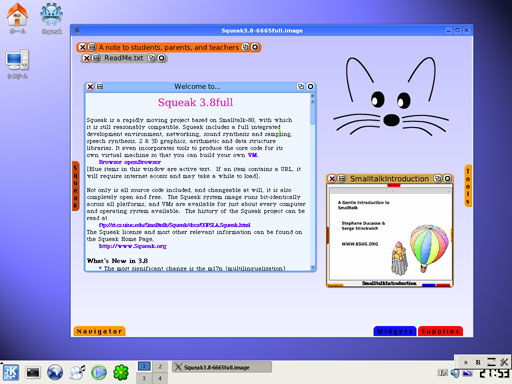
Click on the image to enlarge:
Tuesday, June 20, 2006
SqueakGtk
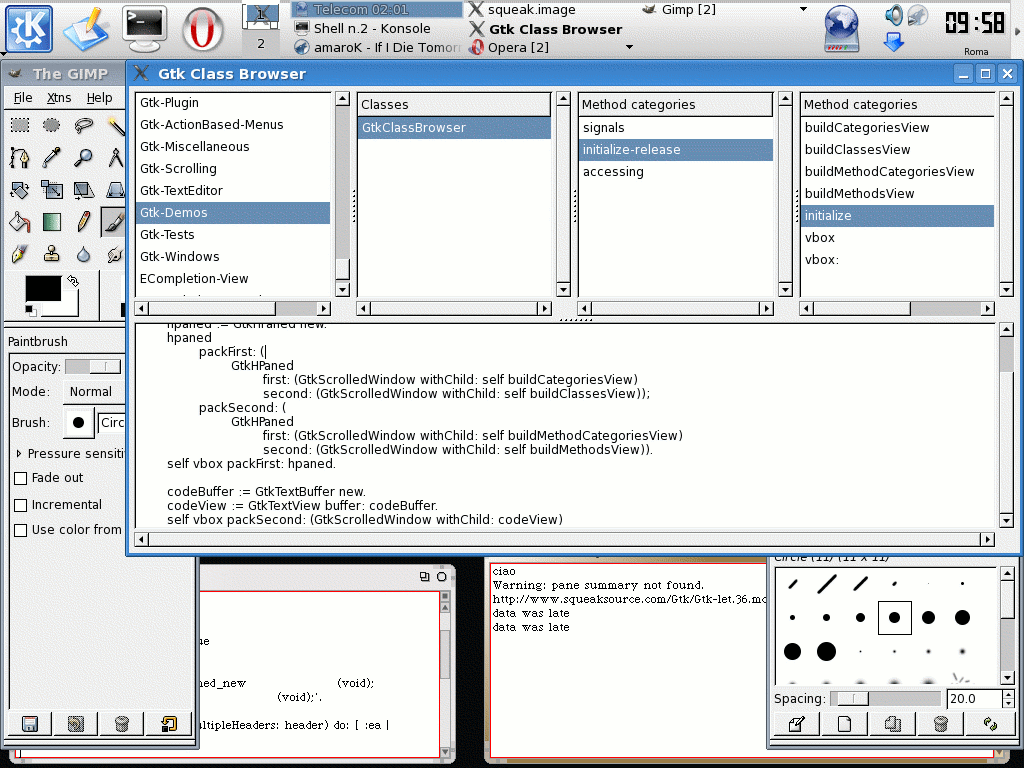
SqueakGtk is an attempt to port the Gtk+ GUI to Squeak - and it looks like the project makes some progress.
Click on the image to enlarge:
Monday, June 19, 2006
VistaSmalltalk
Peter Fisk announced a demonstration of using Smalltalk classes instead of XAML to implement animations in the Windows Presentation Foundation (WPF). He expects Vista Smalltalk will shortly be capable of building online animated games and replacing Javascript for "Ajax" style applications.
Vista Smalltalk is built upon the Windows Presentation Foundation (WPF) classes and a bytecode runtime which depends only upon core WinFx classes.
14th International Smalltalk Conference 2006
The registration for International Smalltalk Conference organised by ESUG every year is now open.
The 14th International Smalltalk Conference 2006 will be held in Prague, Czech Republic.
SqueakNOS Mailinglist
There is a new mailinglist available for the Squeak NOS project.
SqueakNOS is trying to get rid of the OS under Squeak, and to implement all the operating system functionality in Smalltalk.
Wednesday, June 14, 2006
SqSquare collaboration software
Masashi Umezawa announced the SqSquare BETA release.
SqSquare is a new collaboration software built on Tweak. On a virtual broad desktop, you can freely add/edit objects, or even write eToys scripts. There is also a project swiki available.
Monday, June 12, 2006
SqueakNOS: A simple guide to writing HardwareDevices
The "Simple guide to writing HardwareDevices" for SqueakNOS
explains how to use Squeak Smalltalk to implement new
Hardware Devices.
explains how to use Squeak Smalltalk to implement new
Hardware Devices.
Wednesday, June 07, 2006
Seaside, Baby dolls and high volume websites
Nevin Pratt shares some experiences about using Seaside for his web shop.
Monday, May 29, 2006
Friday, May 19, 2006
Squeak NOS is back
The SqueakNOS (Squeak No Operating System) project is back.
SqueakNOS was an attempt to get Squeak running on x86 pcs without an underlying OS. The aim was to push as much of the hardware interface into the Smalltalk image as possible. There has been no progress since 2001 but now the original team is back and SqueakNOS is quite live and quite kicking!
You can either throw away your installed OS (not yet recommended ;) or use PC emulators like VMWare for a first test.
SqueakNOS was an attempt to get Squeak running on x86 pcs without an underlying OS. The aim was to push as much of the hardware interface into the Smalltalk image as possible. There has been no progress since 2001 but now the original team is back and SqueakNOS is quite live and quite kicking!
You can either throw away your installed OS (not yet recommended ;) or use PC emulators like VMWare for a first test.
Squeak NOS is back
The SqueakNOS (Squeak No Operating System) project is back.
SqueakNOS was an attempt to get Squeak running on x86 pcs without an underlying OS. The aim was to push as much of the hardware interface into the Smalltalk image as possible. There has been no progress since 2001 but now the original team is back and SqueakNOS is quite live and quite kicking!
You can either throw away your installed OS (not yet recommended) or use PC emulators like VMWare for a first test.
SqueakNOS was an attempt to get Squeak running on x86 pcs without an underlying OS. The aim was to push as much of the hardware interface into the Smalltalk image as possible. There has been no progress since 2001 but now the original team is back and SqueakNOS is quite live and quite kicking!
You can either throw away your installed OS (not yet recommended) or use PC emulators like VMWare for a first test.
Thursday, May 18, 2006
SqueakNOS is back
The SqueakNOS (Squeak No Operating System) project is back.
SqueakNOS was an attempt to get Squeak running on x86 pcs without an underlying OS. The aim was to push as much of the hardware interface into the Smalltalk image as possible. There has been no progress since 2001 but now the original team is back and SqueakNOS is quite live and quite kicking!
You can either throw away your installed OS (not yet recommended) or use PC emulators like VMWare for a first test.
SqueakNOS was an attempt to get Squeak running on x86 pcs without an underlying OS. The aim was to push as much of the hardware interface into the Smalltalk image as possible. There has been no progress since 2001 but now the original team is back and SqueakNOS is quite live and quite kicking!
You can either throw away your installed OS (not yet recommended) or use PC emulators like VMWare for a first test.
SqueakNOS is back
The SqueakNOS (Squeak No Operating System) project is back.
SqueakNOS was an attempt to get Squeak running on x86 pcs without an underlying OS. The aim was to push as much of the hardware interface into the Smalltalk image as possible. There has been no progress since 2001 but now the original team is back and SqueakNOS is quite live and quite kicking!
You can either throw away your installed OS (not yet recommended) or use PC emulators like VMWare for a first test.
SqueakNOS was an attempt to get Squeak running on x86 pcs without an underlying OS. The aim was to push as much of the hardware interface into the Smalltalk image as possible. There has been no progress since 2001 but now the original team is back and SqueakNOS is quite live and quite kicking!
You can either throw away your installed OS (not yet recommended) or use PC emulators like VMWare for a first test.
Wednesday, May 17, 2006
Just 5 seconds ...
Just read about Sun finishing Java Enterprise Edition 5 on the heise newsticker (german only). One of the added user comments was:
That's really a huge step forward for J2EE - it should now be less painfull to always reboot the webserver after doing refactorings and program changes. ;)
I'm working with both: Java/J2EE and Smalltalk/Seaside and the situation is always the same:
I constantly see the Java world beeing happy about small things making this painfull style of development easier. Nobody asks the question if this change-compile-restart process makes sense in general!!!
On the other hand things like that have never been an issue in dynamic environments like Smalltalk. You dont have to restart the web server after large changes - even if you restructure large parts of your application framework or the web server code itself.
This is one factor why Smalltalk development makes you more productive - you can focus on solving the problem...
"The Sun App server (Glassfish) really rocks. The thing is coming up in only 5 seconds together with derby and admin console. Compared to this most application servers should hide themselves ..."
That's really a huge step forward for J2EE - it should now be less painfull to always reboot the webserver after doing refactorings and program changes. ;)
I'm working with both: Java/J2EE and Smalltalk/Seaside and the situation is always the same:
I constantly see the Java world beeing happy about small things making this painfull style of development easier. Nobody asks the question if this change-compile-restart process makes sense in general!!!
On the other hand things like that have never been an issue in dynamic environments like Smalltalk. You dont have to restart the web server after large changes - even if you restructure large parts of your application framework or the web server code itself.
This is one factor why Smalltalk development makes you more productive - you can focus on solving the problem...
Tuesday, May 09, 2006
Comet implementation for Seaside web framework
Comet - the next web technology after AJAX allows the server to push updates to all clients (for instance web browsers) when they happen.
Diego Gomez Deck published a first implementation on SqueakMap (called Asteroid). It runs with KomHttpServer (Comanche), JSON and Seaside.
I had to patch the class FastSocketStream with a copy of SocketStream>>sendImmediatelly: to make it work in Squeak 3.8. (3.8 uses a different socket implementation and this method was unfortunately missing).
What it does:
=============
After running "ACometWidgets start" in the Squeak server image you can open more than one web browser on http://localhost:9999
You see some text fields - if you change their values the changes are sent to the server and from there dynamically pushed to the other client web browsers without having to use their "refresh" button.
By evaluating "ACometWidgets instance pushAlertHelloWorld." you get an example how to push data (in this case a java script with an alert) from the server to any connected web browser client. If you leave the Transcript open and close the browsers you will also get a notice that they disconnected.
Update:
I created a short Shockwave demo of Asteroids.
Diego Gomez Deck published a first implementation on SqueakMap (called Asteroid). It runs with KomHttpServer (Comanche), JSON and Seaside.
I had to patch the class FastSocketStream with a copy of SocketStream>>sendImmediatelly: to make it work in Squeak 3.8. (3.8 uses a different socket implementation and this method was unfortunately missing).
What it does:
=============
After running "ACometWidgets start" in the Squeak server image you can open more than one web browser on http://localhost:9999
You see some text fields - if you change their values the changes are sent to the server and from there dynamically pushed to the other client web browsers without having to use their "refresh" button.
By evaluating "ACometWidgets instance pushAlertHelloWorld." you get an example how to push data (in this case a java script with an alert) from the server to any connected web browser client. If you leave the Transcript open and close the browsers you will also get a notice that they disconnected.
Update:
I created a short Shockwave demo of Asteroids.
Tuesday, May 02, 2006
Forward to the past
For those of you who want to play with a simple Smalltalk image running on a Java VM (within a browser) try the following link:
Note that Java Webstart is required for your browser. Read the original announcement by Dan Ingalls. The running image is based on the mini.image from Squeak and runs slower than the C based VM but actually it works.
ForwardToThePast.jnlp
Note that Java Webstart is required for your browser. Read the original announcement by Dan Ingalls. The running image is based on the mini.image from Squeak and runs slower than the C based VM but actually it works.
Interview with Dan Ingalls from ESUG 2004
Found an interview with Dan Ingalls from ESUG 2004. Scroll down for the english version. Interesting ...
New beginners squeak mailing-list
A new mailinglist for Squeak beginners has been set up. For a complete list of Squeak related mailinglists click here.
Friday, April 28, 2006
Seaside, ROR and retiring Java from the spotlight of web applications
Seaside got mentioned again in an interview with Ruby on Rails creator David Heinemeier Hansson to retire Java from the spotlight of web applications. To quote:
I would not encourage you to take a look since it is true what Andy Bower once said:
"Rails is much more traditional and familiar to most programmers. Java programmers with years of experience in J2EE can switch to Rails quickly and all they have to learn is what drudgery not to do any more.
Seaside, on the other hand, is an entirely different paradigm. It's new, fresh thinking. And for certain narrow domains it can definitely offer significant improvements over the traditional request/response model.
But I don't see it as something that's going to catch a ton of mainstream traction the way Rails has. It's simply too different for too many people. And for the "most applications most of the time" sphere, it doesn't offer enough benefits over something like Rails to be worth the mental rewrite for most people.
I certainly encourage you to take a look regardless. It'll broaden your mind."
I would not encourage you to take a look since it is true what Andy Bower once said:
"Smalltalk is dangerous. It is a drug. My advice to you would be don't try it; it could ruin your life. Once you take the time to learn it (to REALLY learn it) you will see that there is nothing out there (yet) to touch it. Of course, like all drugs, how dangerous it is depends on your character. It may be that once you've got to this stage you'll find it difficult (if not impossible) to "go back" to other languages and, if you are forced to, you might become an embittered character constantly muttering ascerbic comments under your breath. Who knows, you may even have to quit the software industry altogether because nothing else lives up to your new expectations."
Thursday, April 27, 2006
Wednesday, April 26, 2006
Smalltalk free lectures repository
As announced by Stêphane:
The European Smalltalk User Group ESUG (www.esug.org) hosts a new server to collect all your free Smalltalk lectures and videos:
If you want to share with others your lectures, please visit http://smalltalkteaching.esug.org/
The European Smalltalk User Group ESUG (www.esug.org) hosts a new server to collect all your free Smalltalk lectures and videos:
If you want to share with others your lectures, please visit http://smalltalkteaching.esug.org/
Tuesday, April 25, 2006
Seaside and Exupery Videos
Monday, April 24, 2006
Smalltalk Solutions Pictures
Adriaan van Os announced first pictures from Smalltalk Solutions 2006 in Toronto
Thursday, April 20, 2006
Wednesday, April 19, 2006
Seachart
A new live demo of SeaChart is available at seachart.seasidehosting.st.
SeaChart components are standard Seaside web components that you can easily embed into your Smalltalk web application. Demos include PlotKit
CSS Bar Graph, Numberd List, Star Rater, Fade In and Cross Fade.
You can also download the code from SqueakSource.
Also have a look at scriptaculous.seasidehosting.st for more free Seaside components.
SeaChart components are standard Seaside web components that you can easily embed into your Smalltalk web application. Demos include PlotKit
CSS Bar Graph, Numberd List, Star Rater, Fade In and Cross Fade.
You can also download the code from SqueakSource.
Also have a look at scriptaculous.seasidehosting.st for more free Seaside components.
Tuesday, April 18, 2006
Smalltalk Party in Cagliari, Italy
A new Smalltalk party in Cagliari, Italy will start on July 1st 2006.
Back from New Zealand
After 3 and a half week in New Zealand my wife and I arrived back in germany. It was our second trip to NZ and it was really amazing. I really like the country. This time we concentrated on the North Island and made a trip to White Island. We also saw some Wallabies and a wide range of birdlife.
Our tour in short:
- Auckland (City of Sails)
- Northland with Cape Reinga
- Coromandel
- Bay of Plenty
- Rotorua and Lake Taupo
- Tongariro National Park with its active volcanoes
- New Plymouth with Mt. Taranaki
Our tour in short:
- Auckland (City of Sails)
- Northland with Cape Reinga
- Coromandel
- Bay of Plenty
- Rotorua and Lake Taupo
- Tongariro National Park with its active volcanoes
- New Plymouth with Mt. Taranaki
Tuesday, March 21, 2006
7 Minute Apps
There is a new demo video online about DabbleDB (which is written in Seaside using Squeak Smalltalk).
Just click here to view or download the movie directly (14MB, Quicktime required).
Wednesday, March 15, 2006
About GemStone
Michael Roberts describes some nice features of the GemStone Smalltalk object database. Again we have a nice example for the power of dynamic systems ...
Monday, March 13, 2006
DabbleDB article on techcrunch.com
Smalltalk is getting more and more attention with DabbleDB
(which is written in Squeak using the Seaside web framework).
Read the next article about it.
(which is written in Squeak using the Seaside web framework).
Read the next article about it.
Script.aculo.us and Seaside
A new website shows Seaside combined with the script.aculo.us Javascript library:
http://scriptaculous.seasidehosting.st
Tuesday, March 07, 2006
Beyond Java Buzz
javazoid.com is mentioning Seaside in "Beyond Java Buzz". What I dont understand is that people complain about Java and start with Ruby right after it.
What if they would take the next step and directly start using Smalltalk. I'm sure they will enjoy the wonderfull world full of objects.
Wednesday, February 22, 2006
Seaside Hosting
netstyle.ch and ESUG announced a new website:
http://www.seasidehosting.st
where you can host your seaside image(s). It's free - anything you need is Squeak and Seaside.

http://www.seasidehosting.st
where you can host your seaside image(s). It's free - anything you need is Squeak and Seaside.
Tuesday, February 14, 2006
Monday, February 13, 2006
Thursday, February 09, 2006
New Smalltalk Book in Spanish
Diego Gomez Deck announced a new book about Squeak. It is written in spanish.

You can download the PDF here.
Thursday, January 26, 2006
Squeak and Robots
Jon Hylands (from www.huv.com) posted some new informations about his autonomous controller. The software is written in Squeak Smalltalk.
Click on the images to enlarge and read more on his website.
Thursday, January 19, 2006
Wednesday, January 04, 2006
Wednesday, December 21, 2005
Intelli-Dolphin1.1
Remember the discussion about Smalltalk IDE's and possible problems in Dolphins autocomplete package some days ago?
Meanwhile Tim has announced a new and powerfull auto completion package. Have a look at the flash demo or download the code right here.
Monday, December 19, 2005
Will the future start to happen ...
There is a new webcast presentation available on Croquet technology build in Squeak Smalltalk. I'm not sure which impact this technology will have on computing in the next years but I think it would be wise for many companies to have a look at it before their competitors do...
Monday, December 12, 2005
Today's (Smalltalk) IDE's Part II
The discussion about the power of Smalltalk IDE's continues. Some comments again:
Looks like Talios only accepts an IDE as powerfull if it supports auto completion. Dolphin Smalltalk may have some problems here. But why generalize then?
The eCompletion (Eclipse style completion) package from Squeak works quite nicely and only shows the appropriate selectors:

But there are cases where auto completion is not able to quess the type of an object (for instance when you play with reflection).
I dont claim Smalltalk IDE's to be the holy grail, but compared to other IDE's they are flexible and open. If it doesnt work in Dolphin you can change the auto completion very easily. Ever tried to change the auto completion of VisualStudio? ;)
Looks like Talios only accepts an IDE as powerfull if it supports auto completion. Dolphin Smalltalk may have some problems here. But why generalize then?
The eCompletion (Eclipse style completion) package from Squeak works quite nicely and only shows the appropriate selectors:
But there are cases where auto completion is not able to quess the type of an object (for instance when you play with reflection).
I dont claim Smalltalk IDE's to be the holy grail, but compared to other IDE's they are flexible and open. If it doesnt work in Dolphin you can change the auto completion very easily. Ever tried to change the auto completion of VisualStudio? ;)
Squeak is on fire
Cees has set up a build bot for Squeak 3.9alpha on his website. Read his blog why Squeak is on fire or have a look at his posting to the Squeak mailing list to get more infos.
Thursday, December 08, 2005
Today's (Smalltalk) IDE's
I'm not sure why Cedric Beust (whoever this guy is) should be one of the forward thinkers in the Java community when he says something like this in an interview:
"A lot of veteran developers point out that Smalltalk showed that it was possible to have such an IDE in a dynamic language, but they are only partially right. Today's IDE's are doing much more than anything Smalltalk's environment ever did, so the problem is still wide open (and maybe impossible to solve)."
I used/use both: Smalltalk IDE's and Eclipse/VisualStudio like IDE's - also wrote plugins/goodies/tools for both (including an own standalone IDE). So I know what I'm talking about and have to disagree:
Today's IDE's are doing nothing more than Smalltalk IDE's in the past and present and will never be able to do more than a Smalltalk IDE in the future!
You ask why? Here is my answer:
One can easily build tools in a Smalltalk IDE without spending much time or relying on a predefined plugin architecture. That's why so many features in 'modern' IDE's have their history in Smalltalk. You can also modify the predefined Smalltalk tools to suit your needs since they come with full source code and are easily changeable.
(Ever tried to fix a bug in an Eclipse core package or plugin and you know what I'm talking about)
If there is no predefined Smalltalk tool for your task you can also write a simple script and run it. An example? Let's delete all (S)Unit test cases currently implemented using a single line of code:
Or maybe you need some statistics for your boss: let's count the number of SUnit test case classes in the system:
You can easily access the compiler:
or directly evalute your code in a workspace.
Another example: you want to know how long a particular action or piece of code will take, so just write a profiler script or add the profiler into the particular method:
Next example: we want to watch an object. So just send
to open an inspector showing the object and it's structure. We can also open a browser on the object's class by sending
browsing the behavior and send new messages after that.
Try to do all this in VisualStudio or Eclipse. Even with additional script support added by the vendor/community you will never get the flexibilty of a Smalltalk IDE where you can access anything, including your projects, packages, classes, methods, files and not to forget the language itself. Other scriptable IDE's are mostly limited to predefined objects exposed by the IDE.
And you dont need to know a different scripting language with a different syntax. In a Smalltalk IDE you can use one simple and powerfull language to develop your program, enhance the IDE with tools, build your program and packages and deploy it, ...
So additional stuff like plugin architectures, build systems based on XML (Ant), setup managers, ... are not necessary in Smalltalk. Just use Smalltalk.
In a Smalltalk system there is also no difference between the IDE and the developed application. Typically you throw the IDE out of the image (where any object lives in) before delivering the application. Sometimes an IDE tool is also usefull for the end user of your application so you just leave it there. If you want you can leave the debugger or the whole IDE tools in the deployed application. So you can track problems happening only on the customer side, directly fix them in the debugger and continue running the application...
To transform this example into the java world: try to build and deliver an Eclipse RCP application with the java debugger included, fixing a bug and continue without restarting ...
This is mostly the problem developers from traditionall IDE's face when working with a Smalltalk IDE for the first time. They are too much bound to code in files, IDE tools like a compiler or a debugger as separate application, ...
Maybe some of the Smalltalk IDE's have to catch up with a better look or provide some newbee wizards and templates found in other commercial IDE's. Maybe then people like Cedric Beust will accept to work with them and learn about the power of Smalltalk.
Cees also wonders why anyone is wasting time interviewing this Cedric Beust.
"A lot of veteran developers point out that Smalltalk showed that it was possible to have such an IDE in a dynamic language, but they are only partially right. Today's IDE's are doing much more than anything Smalltalk's environment ever did, so the problem is still wide open (and maybe impossible to solve)."
I used/use both: Smalltalk IDE's and Eclipse/VisualStudio like IDE's - also wrote plugins/goodies/tools for both (including an own standalone IDE). So I know what I'm talking about and have to disagree:
Today's IDE's are doing nothing more than Smalltalk IDE's in the past and present and will never be able to do more than a Smalltalk IDE in the future!
You ask why? Here is my answer:
One can easily build tools in a Smalltalk IDE without spending much time or relying on a predefined plugin architecture. That's why so many features in 'modern' IDE's have their history in Smalltalk. You can also modify the predefined Smalltalk tools to suit your needs since they come with full source code and are easily changeable.
(Ever tried to fix a bug in an Eclipse core package or plugin and you know what I'm talking about)
If there is no predefined Smalltalk tool for your task you can also write a simple script and run it. An example? Let's delete all (S)Unit test cases currently implemented using a single line of code:
TestCase allInstances do: [:each | each removeFromSystem]Or maybe you need some statistics for your boss: let's count the number of SUnit test case classes in the system:
TestCase allSubclasses sizeYou can easily access the compiler:
Compiler evaluate: '3 + 4'or directly evalute your code in a workspace.
Another example: you want to know how long a particular action or piece of code will take, so just write a profiler script or add the profiler into the particular method:
TimeProfiler profile: [self myLongRunningAction]Next example: we want to watch an object. So just send
anObject inspectto open an inspector showing the object and it's structure. We can also open a browser on the object's class by sending
anObject class browse browsing the behavior and send new messages after that.
Try to do all this in VisualStudio or Eclipse. Even with additional script support added by the vendor/community you will never get the flexibilty of a Smalltalk IDE where you can access anything, including your projects, packages, classes, methods, files and not to forget the language itself. Other scriptable IDE's are mostly limited to predefined objects exposed by the IDE.
And you dont need to know a different scripting language with a different syntax. In a Smalltalk IDE you can use one simple and powerfull language to develop your program, enhance the IDE with tools, build your program and packages and deploy it, ...
So additional stuff like plugin architectures, build systems based on XML (Ant), setup managers, ... are not necessary in Smalltalk. Just use Smalltalk.
In a Smalltalk system there is also no difference between the IDE and the developed application. Typically you throw the IDE out of the image (where any object lives in) before delivering the application. Sometimes an IDE tool is also usefull for the end user of your application so you just leave it there. If you want you can leave the debugger or the whole IDE tools in the deployed application. So you can track problems happening only on the customer side, directly fix them in the debugger and continue running the application...
To transform this example into the java world: try to build and deliver an Eclipse RCP application with the java debugger included, fixing a bug and continue without restarting ...
This is mostly the problem developers from traditionall IDE's face when working with a Smalltalk IDE for the first time. They are too much bound to code in files, IDE tools like a compiler or a debugger as separate application, ...
Maybe some of the Smalltalk IDE's have to catch up with a better look or provide some newbee wizards and templates found in other commercial IDE's. Maybe then people like Cedric Beust will accept to work with them and learn about the power of Smalltalk.
Cees also wonders why anyone is wasting time interviewing this Cedric Beust.
Wednesday, December 07, 2005
SqueakSource Server image
I managed to build a working SqueakSource server image using the instructions from http://source.squeakfoundation.org.
With this predefined image you are able to run an own local SqueakSource repository server very easily.
Cees De Groot will host the image and put a download link onto the project page tomorrow. Here is a short preview of the image and the server running on localhost:


Many thanks to Doug Way for the instructions, the SqueakSource authors for this nice piece of Software, Cees for hosting and others who helped to make it available.
With this predefined image you are able to run an own local SqueakSource repository server very easily.
Cees De Groot will host the image and put a download link onto the project page tomorrow. Here is a short preview of the image and the server running on localhost:
Many thanks to Doug Way for the instructions, the SqueakSource authors for this nice piece of Software, Cees for hosting and others who helped to make it available.
ComSwiki 1.5
Jochen "Jeff" Rick (J77) has announced a new version of ComSwiki (codename "One Of These Days").
The new release includes AniAniWeb - a personal home page system.
Tuesday, November 29, 2005
SqueakMap 2.1
Göran has announced the new version 2.1 of SqueakMap.
The SqueakMap website is now also available at http://map.squeak.org
Wednesday, November 23, 2005
Tuesday, November 22, 2005
Thursday, November 17, 2005
Tuesday, November 15, 2005
Techo with Shout
Found a nice tool on SqueakMap today. It is called "Techo" - something like
a multi notepad. Many thanks to Takashi Yamamiya for implementing this little tool.
Since I want to use it as a workspace script manager I created a "Shout" and "eCompletion"
aware version of it to support Smalltalk syntax highlighting.
To install in Squeak 3.8#6665 using the SM Package loader:
- install "Shout" version 4 (may already be installed)
- install "ShoutWorkspace" version 2
- install "eCompletion" version 2.0b2
- install "TechoShout" version 1
Open Techo using 'open' in the world menu or evaluate "Techo open".
Now you can create workspace scripts. Note that Techo used the first line
as the name for the script - so I typically write the scripts using a first line comment:
a multi notepad. Many thanks to Takashi Yamamiya for implementing this little tool.
Since I want to use it as a workspace script manager I created a "Shout" and "eCompletion"
aware version of it to support Smalltalk syntax highlighting.
To install in Squeak 3.8#6665 using the SM Package loader:
- install "Shout" version 4 (may already be installed)
- install "ShoutWorkspace" version 2
- install "eCompletion" version 2.0b2
- install "TechoShout" version 1
Open Techo using 'open' in the world menu or evaluate "Techo open".
Now you can create workspace scripts. Note that Techo used the first line
as the name for the script - so I typically write the scripts using a first line comment:
"001 - Open a new Techo"
Techo open.Monday, November 14, 2005
Seaside PR
Bruce Tate, author of three best-selling Java books comments on Seaside in his latest article.
Also the latest Weekly Squeak issue includes an interview with Bruce and Avi (author of the seaside framework) explains the history of Seaside.
Smalltalk next door
Dont know where to find the Smalltalker next door or
Squeakers in the neighbourhood - so have a look at frappr.com.
Tuesday, November 08, 2005
Exupery
Exupery is a compiler written in Squeak Smalltalk that compiles bytecodes to machine code. You can read more about it on the Squeak swiki.
There is also a new gmane interface to the Exupery mailinglist.
Monday, November 07, 2005
Wednesday, October 26, 2005
Squeakware
Squeakware is a compact, customizable Squeak-built-in Linux. It's based on "Slax Linux". Click on the images to enlarge:
Monday, October 24, 2005
Reimplementing Eclipse?
If they really want to bring more Smalltalk experience into Eclipse I would vote for reimplementing it using a pure and dynamic OO language. ;)
Maybe they should have a look at Squeak - it's open source, not controlled by vendors and it's community is growing fast.
Thursday, October 20, 2005
Seaside in O'Reilly article
Seaside (the Smalltalk web framework based on Squeak) is mentioned in an O'Reilly article:
"Web programming is an absolute disaster. After ten years of Java programming, we still haven't built a framework to get the Back button right. Web applications are stateless, so web applications scale better. But stateless applications are hard to build, and our frameworks do not give us much help. With most Java web frameworks, you basically build many unrelated pieces of the application using servlets or JSP, and then wire them together by manually saving objects that you need in temporary storage objects called sessions."
...
"Continuation-based web frameworks generally make web development much easier by simulating a stateful application."
...
"The best continuation-based frameworks are developed in dynamic languages. By far, the most robust is Seaside. It's a framework based on Squeak, a Smalltalk dialect. Seaside features fantastic debugging support--you can actually inspect, debug, and change your code from a browser"
I also like the Conclusion:
"In Beyond Java, I make the case that Java's not dead yet, but for the first time in nearly a decade, we're seeing compelling innovation happen beyond the borders of Java. These four technologies will play an important role in the near future. Watch them closely."
But I would not totally agree: in Smalltalk innovation happens all the time!
"Web programming is an absolute disaster. After ten years of Java programming, we still haven't built a framework to get the Back button right. Web applications are stateless, so web applications scale better. But stateless applications are hard to build, and our frameworks do not give us much help. With most Java web frameworks, you basically build many unrelated pieces of the application using servlets or JSP, and then wire them together by manually saving objects that you need in temporary storage objects called sessions."
...
"Continuation-based web frameworks generally make web development much easier by simulating a stateful application."
...
"The best continuation-based frameworks are developed in dynamic languages. By far, the most robust is Seaside. It's a framework based on Squeak, a Smalltalk dialect. Seaside features fantastic debugging support--you can actually inspect, debug, and change your code from a browser"
I also like the Conclusion:
"In Beyond Java, I make the case that Java's not dead yet, but for the first time in nearly a decade, we're seeing compelling innovation happen beyond the borders of Java. These four technologies will play an important role in the near future. Watch them closely."
But I would not totally agree: in Smalltalk innovation happens all the time!
Thursday, October 13, 2005
Thursday, October 06, 2005
Yet another frustrated developer...
Currently Java (especially J2EE) is getting too complex and this will frustrate more and more developers.
It is true that compared to Java you are much more productive - but Smalltalk is still the winner for developer productivity. It is also much easier to use - if you are willing to think in plain objects and messages. So leave the curly braces behind you and start by reading one of the free Smalltalk books.
Tuesday, October 04, 2005
Squeak homepage
The new Squeak homepage is up and running. Visit http://www.squeak.org and read more. It is based on SmallWiki.
Thursday, September 22, 2005
Sunday, September 18, 2005
Thursday, September 01, 2005
VA Smalltalk 7.0
The Windows download for VA Smalltalk 7.0 (VAST) is available here. Downloads for Linux, AIX and Solaris will be available soon.
VA Smalltalk is the former VisualAge for Smalltalk product from IBM. The product development and support is now done by Instantiations - and I'm sure this will help moving the product and customers forward.
Wednesday, August 31, 2005
Susie - Smalltalk scripting
Susie is an attempt to provide a light weight scripting engine using Smalltalk as the language. it is based on
PublicDomainSmallTalk, which in turn is based on LittleSmalltalk.
Tuesday, August 30, 2005
Monday, August 29, 2005
Cloth again
Orion Elenzil put together a nice Croquet demo.
Read more here. He also points to a silly flash file called the "Falling Woman demo". If you ever wanted to know the difference between Vernet integration and Euler read about his first demo.
Seaside Presentation Movie
Squeak and Smalltalk related videos
ESUG (European Smalltalk Usergroup) announced the following videos available at Google Video:
What is Squeak? (Alan Kay)
http://tinyurl.com/a53zm
Squeak and Croquet Demo Etech03 (Alan Kay and David A. Smith)
http://tinyurl.com/bywxe
Croquet: A Collaboration Architecture (Alan Kay and David A. Smith)
http://tinyurl.com/cgcms
The Computer Revolution hasn't happend yet. Keynote OOPSLA 1997 (Alan
Kay)
http://tinyurl.com/9vgdl
Beyond VI -- Talk from euroko03 (Marcus Denker)
http://tinyurl.com/dczzt
Alan Kay: Education in the Digital Age
http://tinyurl.com/8trwq
Alan Kay: Graphical User Interfaces
http://tinyurl.com/daocv
Bytecode-to-bytecode adaptive optimization for Smalltalk (Eliot Miranda)
http://tinyurl.com/dparf
Dan Ingalls: Object-Oriented Programming
http://tinyurl.com/784jk
Alan Kay: Doing with Images Makes Symbols
http://tinyurl.com/cpgjz
Self; The Video
http://tinyurl.com/8q6ku
Doug Engelbart: The Demo
http://tinyurl.com/d9r9w
What is Squeak? (Alan Kay)
http://tinyurl.com/a53zm
Squeak and Croquet Demo Etech03 (Alan Kay and David A. Smith)
http://tinyurl.com/bywxe
Croquet: A Collaboration Architecture (Alan Kay and David A. Smith)
http://tinyurl.com/cgcms
The Computer Revolution hasn't happend yet. Keynote OOPSLA 1997 (Alan
Kay)
http://tinyurl.com/9vgdl
Beyond VI -- Talk from euroko03 (Marcus Denker)
http://tinyurl.com/dczzt
Alan Kay: Education in the Digital Age
http://tinyurl.com/8trwq
Alan Kay: Graphical User Interfaces
http://tinyurl.com/daocv
Bytecode-to-bytecode adaptive optimization for Smalltalk (Eliot Miranda)
http://tinyurl.com/dparf
Dan Ingalls: Object-Oriented Programming
http://tinyurl.com/784jk
Alan Kay: Doing with Images Makes Symbols
http://tinyurl.com/cpgjz
Self; The Video
http://tinyurl.com/8q6ku
Doug Engelbart: The Demo
http://tinyurl.com/d9r9w
Tuesday, August 23, 2005
Writing customized UI's using Morphic
Had a little bit time this evening. Not enough to do anything serious with Smalltalk - but enough to answer a question on the Squeak mailing list by writing a simplified "Handy Simulator". It's only behavior is to switch the screen on and off by using the power button.
It's a nice example of using morphic to build a customized user interface. The package is registered on SqueakSource and can directly be loaded into squeak using the SqueakMap package browser.
Free OmniBase
Looks like the OmniBase Object Database for Smalltalk is now free. The download page includes:
"OmniBase is available for free for commercial and educational purposes. Free version of OmniBase is prohibited to be used in the oil or military industries."
There are versions for several Smalltalk dialects: Squeak, Dolphin, VisualWorks, VisualAge and ST/X.
"OmniBase is available for free for commercial and educational purposes. Free version of OmniBase is prohibited to be used in the oil or military industries."
There are versions for several Smalltalk dialects: Squeak, Dolphin, VisualWorks, VisualAge and ST/X.
Monday, August 22, 2005
VAST7 RC1
Eric mentioned that the Release Candidate 1 (RC1) of the Windows Version of VA Smalltalk 7 is available on the Instantiations website.
Tuesday, August 16, 2005
Bicephale project
Michal announced the first version of his "Bicephale project" which tries to change Seaside to make it handle elegantly the display of static, long-lived objects.
Note that it is early code - but since the package contains no modification to base Seaside classes it should be harmless to install it into your Seaside image.
Interim Pollock Release
Samuel S. Shuster has published an interim version of Pollock to the Cincom Public Repository. Pollock is the new GUI framework for VisualWorks Smalltalk.
Read more in the newsgroup or on his blog.
Sunday, August 14, 2005
3D Browser
Friday, August 12, 2005
Planet Squeak
Simon Michael has set up an experimental "planet" site for Squeak. "planet" sites are RSS feed aggregators. Actually there are 3 aggregators at the moment:
http://squeak.joyful.com/planetsqueak
http://squeak.joyful.com/planetsqueak2
http://squeak.joyful.com/planetsqueakarchive
http://squeak.joyful.com/planetsqueak
http://squeak.joyful.com/planetsqueak2
http://squeak.joyful.com/planetsqueakarchive
Wednesday, August 10, 2005
Why an image is helpfull for development
There is a discussion about Ruby vs. Smalltalk and file based development vs. image based development. I could'nt resist to add my 2 cents.
Monday, August 08, 2005
Another Dolphin Smalltalk game
Paolo from Italy has created a sudoku game with the free Dolphin Smalltalk version from the lates Bitwise magazin issue.
Tuesday, August 02, 2005
Free Dolphin Smalltalk
The issue #3 of the Bitwise magazine (http://www.bitwisemag.com) provides a free download of Dolphin Smalltalk. So you can follow the step by step tutorial and jump on the Smalltalk bandwagon...
Monday, August 01, 2005
Dalektron Smalltalk Game Website
Andy from Object-Arts announced a new website for the Dalektron game. The game is written in Dolphin Smalltalk.
Monday, July 25, 2005
Generating CS Papers ...
ohhh - what a usefull tool! There is a computer science paper generator online available. So some authors dont have to waste their time writing papers before creating presentations like
- "From Brain to {Your favourite technology}"
- "Migrating apples to oranges"
- "Waste you time with the next framework"
- "My theory is better than yours"
- "How to stay in business with free software"
- "How to build hello world with 39 screenshots"
- ...
Thursday, July 21, 2005
Collogia and Cincom Smalltalk
The german Collogia AG has announced a new product "CollPhir ZWK" created with Cincom Smalltalk for pension management.
Read the press material (german only).
Looks like most of their products are Visual Works based. At least one can guess that from the available screenshots in the info material.
Read the press material (german only).
Looks like most of their products are Visual Works based. At least one can guess that from the available screenshots in the info material.
Tuesday, July 19, 2005
Smalltalk is easier ... even in school
Found this picture on a friends website.

Yes: life was hard for me too when I was a little boy in primary (C++) school. Later in higher Smalltalk education the program was much easier to write and understand:
500 timesRepeat: [Transcript show: 'I will not throw paper airplanes in class.']
Monday, July 18, 2005
Chronos Date/Time Library
The Chronos Date/Time Library is reusable code library written in Smalltalk for the creation of and computations with date and time values. It's available at http://chronos-st.org. Note that the license says: "Porting Chronos to non-Smalltalk programming languages is strictly prohibited." - so it's Smalltalk only.
Wednesday, July 13, 2005
Live Shore Components demo
The shore components demo (a component library for seaside) is now running live on the seaside website. Just point your browser to http://shorecomponents.seaside.st. The demo includes some of my seaside examples (SVG, file download, embedded browser and web tree)

Since the project is hosted on SqueakSource I hope that others will contribute some components too.
Sunday, July 10, 2005
DALEKTRON Game in Smalltalk
Andy Bower created a game together with his eldest son James, before the spectres of the curly braces get hold of him.
Read more here, download the game or click on one of the screenshots below.
Wednesday, July 06, 2005
Monday, July 04, 2005
A talk on the Seaside ...
Avi Bryant will be speaking in London about Seaside on the evening of Tuesday the 19th of July at the Old Bank of England. Read more here.
Component library for Seaside
Jan B. Krejčí announced a new project called "Shore Components" - a component library for the Seaside web framework.

It is hosted on SqueakSource, so you can add the following HTTP based Monticello repository to your Squeak image and load it:
After running "WAKom startOn: 9092" point you browser to http://localhost:9092/seaside/ShoreDemo1
It is hosted on SqueakSource, so you can add the following HTTP based Monticello repository to your Squeak image and load it:
MCHttpRepository
location: 'http://www.squeaksource.com/ShoreComponents'
user: ''
password: ''
After running "WAKom startOn: 9092" point you browser to http://localhost:9092/seaside/ShoreDemo1
Friday, July 01, 2005
Smalltalk Tutorial for Beginners Part 2
The online magazine BitwiseMag.com has published the second issue including the second part of the Smalltalk Tutorial.
Subscribe to:
Posts (Atom)