Göran has announced the new version 2.1 of SqueakMap.
The SqueakMap website is now also available at http://map.squeak.org
Tuesday, November 29, 2005

Wednesday, November 23, 2005

Tuesday, November 22, 2005

Thursday, November 17, 2005
Tuesday, November 15, 2005
Techo with Shout
Found a nice tool on SqueakMap today. It is called "Techo" - something like
a multi notepad. Many thanks to Takashi Yamamiya for implementing this little tool.
Since I want to use it as a workspace script manager I created a "Shout" and "eCompletion"
aware version of it to support Smalltalk syntax highlighting.
To install in Squeak 3.8#6665 using the SM Package loader:
- install "Shout" version 4 (may already be installed)
- install "ShoutWorkspace" version 2
- install "eCompletion" version 2.0b2
- install "TechoShout" version 1
Open Techo using 'open' in the world menu or evaluate "Techo open".
Now you can create workspace scripts. Note that Techo used the first line
as the name for the script - so I typically write the scripts using a first line comment:

a multi notepad. Many thanks to Takashi Yamamiya for implementing this little tool.
Since I want to use it as a workspace script manager I created a "Shout" and "eCompletion"
aware version of it to support Smalltalk syntax highlighting.
To install in Squeak 3.8#6665 using the SM Package loader:
- install "Shout" version 4 (may already be installed)
- install "ShoutWorkspace" version 2
- install "eCompletion" version 2.0b2
- install "TechoShout" version 1
Open Techo using 'open' in the world menu or evaluate "Techo open".
Now you can create workspace scripts. Note that Techo used the first line
as the name for the script - so I typically write the scripts using a first line comment:
"001 - Open a new Techo"
Techo open.
Monday, November 14, 2005
Seaside PR
Bruce Tate, author of three best-selling Java books comments on Seaside in his latest article.
Also the latest Weekly Squeak issue includes an interview with Bruce and Avi (author of the seaside framework) explains the history of Seaside.
Also the latest Weekly Squeak issue includes an interview with Bruce and Avi (author of the seaside framework) explains the history of Seaside.
Smalltalk next door
Dont know where to find the Smalltalker next door or
Squeakers in the neighbourhood - so have a look at frappr.com.
Squeakers in the neighbourhood - so have a look at frappr.com.
Tuesday, November 08, 2005
Exupery
Exupery is a compiler written in Squeak Smalltalk that compiles bytecodes to machine code. You can read more about it on the Squeak swiki.
There is also a new gmane interface to the Exupery mailinglist.
There is also a new gmane interface to the Exupery mailinglist.
Monday, November 07, 2005
Wednesday, October 26, 2005
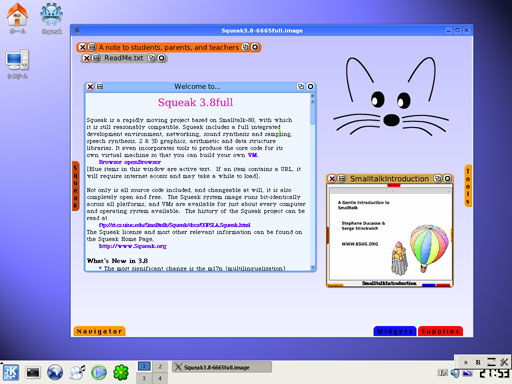
Squeakware
Squeakware is a compact, customizable Squeak-built-in Linux. It's based on "Slax Linux". Click on the images to enlarge:


Monday, October 24, 2005
Reimplementing Eclipse?
If they really want to bring more Smalltalk experience into Eclipse I would vote for reimplementing it using a pure and dynamic OO language. ;)
Maybe they should have a look at Squeak - it's open source, not controlled by vendors and it's community is growing fast.
Maybe they should have a look at Squeak - it's open source, not controlled by vendors and it's community is growing fast.
Thursday, October 20, 2005
Seaside in O'Reilly article
Seaside (the Smalltalk web framework based on Squeak) is mentioned in an O'Reilly article:
"Web programming is an absolute disaster. After ten years of Java programming, we still haven't built a framework to get the Back button right. Web applications are stateless, so web applications scale better. But stateless applications are hard to build, and our frameworks do not give us much help. With most Java web frameworks, you basically build many unrelated pieces of the application using servlets or JSP, and then wire them together by manually saving objects that you need in temporary storage objects called sessions."
...
"Continuation-based web frameworks generally make web development much easier by simulating a stateful application."
...
"The best continuation-based frameworks are developed in dynamic languages. By far, the most robust is Seaside. It's a framework based on Squeak, a Smalltalk dialect. Seaside features fantastic debugging support--you can actually inspect, debug, and change your code from a browser"
I also like the Conclusion:
"In Beyond Java, I make the case that Java's not dead yet, but for the first time in nearly a decade, we're seeing compelling innovation happen beyond the borders of Java. These four technologies will play an important role in the near future. Watch them closely."
But I would not totally agree: in Smalltalk innovation happens all the time!
"Web programming is an absolute disaster. After ten years of Java programming, we still haven't built a framework to get the Back button right. Web applications are stateless, so web applications scale better. But stateless applications are hard to build, and our frameworks do not give us much help. With most Java web frameworks, you basically build many unrelated pieces of the application using servlets or JSP, and then wire them together by manually saving objects that you need in temporary storage objects called sessions."
...
"Continuation-based web frameworks generally make web development much easier by simulating a stateful application."
...
"The best continuation-based frameworks are developed in dynamic languages. By far, the most robust is Seaside. It's a framework based on Squeak, a Smalltalk dialect. Seaside features fantastic debugging support--you can actually inspect, debug, and change your code from a browser"
I also like the Conclusion:
"In Beyond Java, I make the case that Java's not dead yet, but for the first time in nearly a decade, we're seeing compelling innovation happen beyond the borders of Java. These four technologies will play an important role in the near future. Watch them closely."
But I would not totally agree: in Smalltalk innovation happens all the time!
Thursday, October 13, 2005
Thursday, October 06, 2005
Yet another frustrated developer...
Currently Java (especially J2EE) is getting too complex and this will frustrate more and more developers.
It is true that compared to Java you are much more productive - but Smalltalk is still the winner for developer productivity. It is also much easier to use - if you are willing to think in plain objects and messages. So leave the curly braces behind you and start by reading one of the free Smalltalk books.

It is true that compared to Java you are much more productive - but Smalltalk is still the winner for developer productivity. It is also much easier to use - if you are willing to think in plain objects and messages. So leave the curly braces behind you and start by reading one of the free Smalltalk books.
Tuesday, October 04, 2005
Squeak homepage
The new Squeak homepage is up and running. Visit http://www.squeak.org and read more. It is based on SmallWiki.
Thursday, September 22, 2005
Sunday, September 18, 2005
Thursday, September 01, 2005
VA Smalltalk 7.0
The Windows download for VA Smalltalk 7.0 (VAST) is available here. Downloads for Linux, AIX and Solaris will be available soon.
VA Smalltalk is the former VisualAge for Smalltalk product from IBM. The product development and support is now done by Instantiations - and I'm sure this will help moving the product and customers forward.

VA Smalltalk is the former VisualAge for Smalltalk product from IBM. The product development and support is now done by Instantiations - and I'm sure this will help moving the product and customers forward.
Wednesday, August 31, 2005
Susie - Smalltalk scripting
Susie is an attempt to provide a light weight scripting engine using Smalltalk as the language. it is based on
PublicDomainSmallTalk, which in turn is based on LittleSmalltalk.
PublicDomainSmallTalk, which in turn is based on LittleSmalltalk.
Subscribe to:
Posts (Atom)